AI Search Presence: 8 Tools to Track Your Brand
The Shift from Blue Links to AI-Generated Answers
AI content visibility measures how frequently and prominently your brand, content, or expertise appears in AI-generated answers from platforms like ChatGPT, Google AI Overviews, Perplexity, and Gemini. Unlike traditional SEO rankings, AI visibility focuses on citations, mentions, and contextual references within synthesized responses—not just link positions.
Quick Answer: What Determines AI Content Visibility?
| Factor | What It Means |
|---|---|
| Entity Recognition | Can AI systems identify your brand as a distinct, trustworthy source? |
| Citation Frequency | How often do LLMs reference your content when answering queries? |
| Structural Clarity | Is your content easy for AI to parse, extract, and repackage? |
| E-E-A-T Signals | Does your content demonstrate Experience, Expertise, Authoritativeness, and Trust? |
| Share of Voice | How visible is your brand compared to competitors in AI answers? |
Every week, more search journeys begin and end inside AI-generated answers. Users ask conversational questions, and AI assistants synthesize responses before a click happens.
According to Bain & Company, about 80% of search users rely on AI summaries at least 40% of the time, and roughly 60% of searches now end without users clicking through to a website. McKinsey research confirms that generative search has become the preferred method for most users.
This isn’t a temporary shift. It’s a fundamental change in how people discover information.
The challenge: If your brand isn’t appearing in these AI-generated answers, you’re essentially invisible to a growing segment of your audience—even if you rank well in traditional search results.
The opportunity: Small brands can compete effectively in AI search by focusing on clarity, structure, and consistency rather than just link volume or domain authority.
This guide covers eight practical methods to track your AI content visibility, measure what matters, and optimize your content for the age of answer engines. We’ll focus on real tracking approaches, meaningful metrics, and strategic adjustments backed by industry research and emerging best practices.
AI content visibility definitions:
Defining AI Content Visibility in the Age of Answer Engines
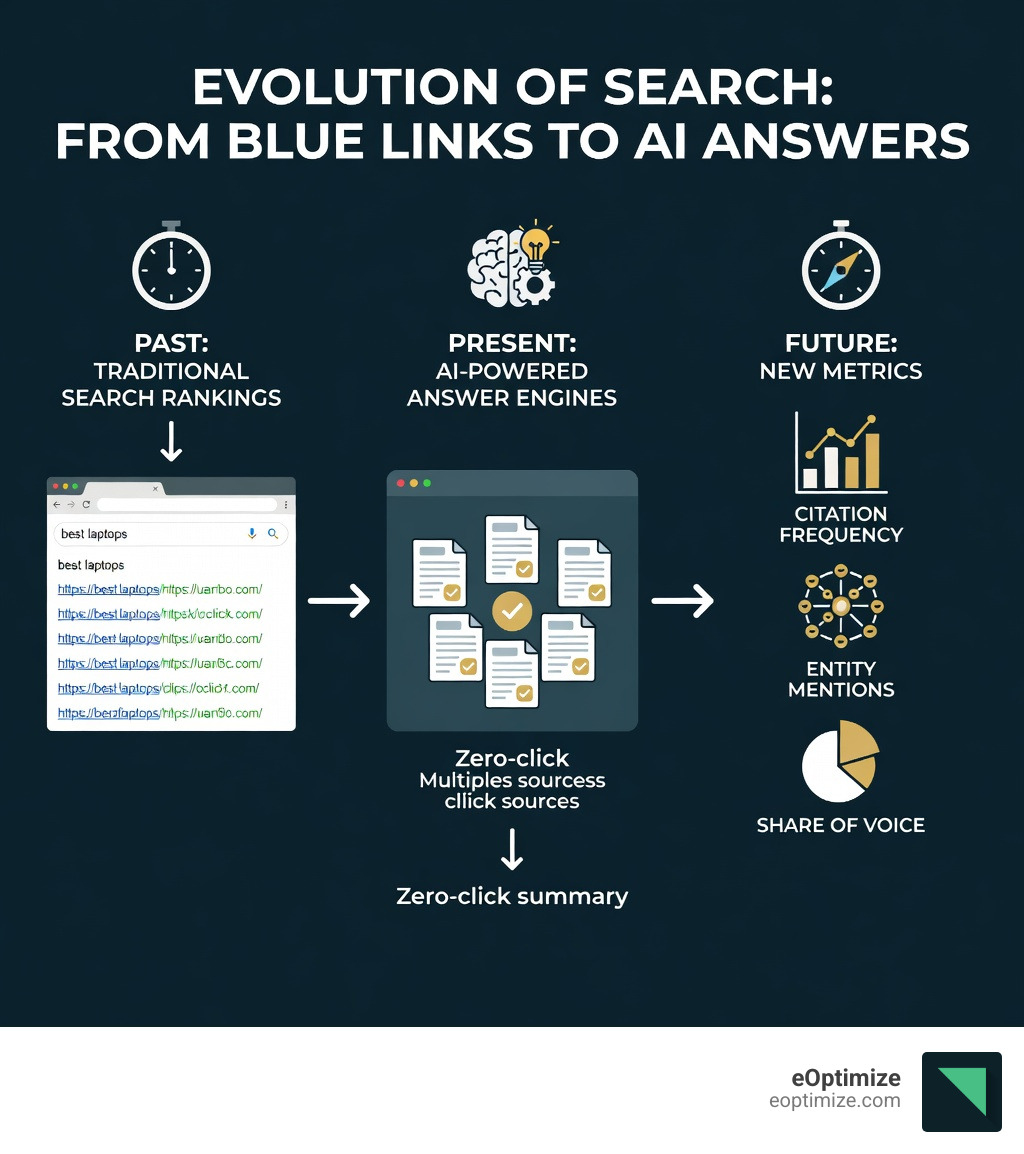
Traditional SEO has always focused on position. If you were in the top three “blue links,” you were successful. However, the rise of AI content visibility has introduced a new paradigm: information synthesis. Instead of providing a list of websites, modern answer engines like ChatGPT and Perplexity pull data from various sources to create a single, cohesive response.
This shift means that “presence” is now more important than “position.” You don’t just want to be a link on the page; you want to be the source of the facts the AI is stating. For more context on this transition, you can explore AI search impact to see how these models are reshaping user behavior.
Key differences include:
- Retrieval vs. Interpretation: Traditional search retrieves a page; AI search interprets the content on that page to answer a specific prompt.
- Citation Frequency: This measures how often an LLM (Large Language Model) chooses your site as a reference.
- Brand Mentions: In conversational search, your brand might be mentioned as a recommendation even if a link isn’t provided.
As McKinsey notes, generative search is already the favorite of most users, meaning visibility within these summaries is the new “page one.”
Key Metrics for Measuring Your AI Search Presence
To track your success in this new landscape, you need a different set of KPIs. Traditional metrics like click-through rate (CTR) are becoming less reliable because many AI interactions result in “zero-click” searches.
AI Visibility Score
This is an emerging metric that quantifies how often your brand is featured in AI-generated answers across various platforms. It moves beyond simple rankings to measure whether AI systems recognize and trust your brand enough to reuse your content.
Share of Voice (SOV)
In the AI era, SOV measures your brand’s prominence in AI answers compared to your competitors. If a user asks for the “best digital marketing agencies,” does the AI mention your brand consistently, or does it favor others?

Entity Mention Velocity
AI models operate on “entities”—distinct, identifiable concepts or brands. Entity mention velocity tracks how quickly and frequently your brand is being recognized as an authority across the digital ecosystem. This is a critical factor for how to improve brand visibility in AI-driven search results.
Citation Readability Score
This technical metric assesses how easily an AI agent can parse and understand your webpage. If your content is buried in complex code or unoptimized PDFs, your Citation Readability Score will be low, reducing your visibility. Scientific research on Visibility into AI Agents highlights that real-time monitoring of how these agents interact with content is essential for modern governance.
8 Essential Methods to Track and Improve AI Content Visibility
Tracking AI content visibility requires a mix of technical audits, competitive analysis, and real-time monitoring. Below is a comparison of the primary methods used to evaluate your presence in generative search.
| Method | Primary Focus | Key Benefit |
|---|---|---|
| AI Visibility Audits | Content Structure | Identifies parsing errors |
| Brand Mention Analysis | LLM Citations | Tracks authority |
| Competitive Benchmarking | Industry SOV | Comparative insights |
| Narrative Consistency | Brand Voice | Ensures accurate framing |
| Segmentation | Persona Targets | Granular data |
| Sentiment Analysis | Brand Perception | Detects bias or risk |
| Channel Monitoring | Platform Reach | Multi-engine tracking |
| Content Gap Audits | Missing Topics | Growth opportunities |
For a deeper dive into specific software, see our guide on the best tools for tracking brand visibility in AI search results.
1. AI Visibility Audits
An AI visibility audit checks how “readable” your site is for LLM crawlers. It looks for structural issues that might prevent an AI from extracting your key facts. These audits focus on accuracy and user-friendliness, ensuring that your most important data points are presented in a way that AI systems can easily ingest.
2. Brand Mention Analysis
This involves monitoring how your brand is described when LLMs answer queries related to your industry. Are you described as a “premium provider” or a “budget option”? By analyzing real AI responses, you can see if the AI’s “perception” of your brand aligns with your actual positioning.
3. Competitive Benchmarking
You cannot measure success in a vacuum. Competitive benchmarking allows you to see exactly how often competitors are being recommended over you. This is vital for enterprise-scale brands that need to maintain a dominant share of voice across millions of potential conversational prompts.
4. Narrative Consistency Checks
AI systems summarize and contextualize information. If your messaging is inconsistent across the web, the AI may misinterpret your offering. Consistency checks ensure that your brand narrative remains stable, which is a strategic asset for accurate interpretation by AI assistants.
5. Segmentation and Filtering
Effective tracking requires segmenting data by buyer persona or theme. For example, you might have high visibility for “technical specifications” but low visibility for “pricing comparisons.” Using intuitive filters helps you identify specific areas where your AI content visibility needs a boost.
6. Sentiment and Context Analysis
It is not enough to be mentioned; you must be mentioned positively. Sentiment analysis tools scan AI responses to ensure your brand isn’t being associated with negative context or “representation risk”—where the AI oversimplifies or misstates your brand’s values.
7. Location and Channel Monitoring
While many LLMs operate at a national level, some integrations (like Google AI Overviews) are increasingly considering local relevance. Monitoring across different channels—ChatGPT, Gemini, Perplexity, and Bing—is essential because each engine uses a slightly different index and set of priorities.
8. Content Gap and Optimization Audits
By identifying which questions your competitors are answering that you aren’t, you can perform content gap audits. This allows you to write new, optimized articles that target high-impact queries where AI is currently looking for better sources.
Strategic Optimization: Boosting Your AI Content Visibility
Once you are tracking your metrics, the next step is optimization. This is often called Generative Engine Optimization (GEO) or Answer Engine Optimization (AEO).
Structural and Semantic Clarity
AI search parses content into modular pieces. To be selected, your content must be easy to “lift.” Use:
- Defined Headings (H2s and H3s): Use descriptive, question-based headings.
- Q&A Formats: Directly answer common questions in a concise manner.
- Lists and Tables: These are highly “extractable” for AI summaries.
The Power of Schema.org
Schema.org markup is the “translator” between your human-readable text and the machine-readable data LLMs crave. By implementing structured data, you provide AI engines with the context they need to cite you with confidence. For a full breakdown, see our LLM content optimization complete guide.
Strengthening E-E-A-T
Google’s E-E-A-T guidelines (Experience, Expertise, Authoritativeness, and Trustworthiness) are more relevant than ever. AI models are conservative; they prioritize sources that demonstrate clear expertise and verified facts. You can optimize content for AI by including author bios, citing primary research, and maintaining a secure, high-quality site.
Future Trends and Risks in AI Search Visibility
As we look toward 2026 and beyond, several trends will further complicate AI content visibility.
- Multi-modal Search: Users are beginning to search using images and voice. AI visibility will soon include how well your images are interpreted and how “speakable” your content is for voice assistants.
- Conversational Interfaces: Search is becoming a back-and-forth dialogue. Brands will need to optimize for follow-up questions, not just the initial prompt.
- Agentic Workflows: We are moving toward a world where AI agents book holidays or buy products on behalf of users. Visibility into these agents’ decision-making processes is a new frontier for digital strategy.
However, there are risks. Hallucination risks—where an AI makes up facts about your brand—can damage your reputation. Additionally, data privacy remains a concern as AI models ingest more proprietary information. Understanding these key factors for brand visibility in generative AI is essential for mitigating these risks while you unleash your content’s potential with AI optimization.
Frequently Asked Questions about AI Content Visibility
What is the difference between AI visibility and traditional SEO?
Traditional SEO focuses on ranking a URL in a list of results to drive clicks. AI visibility focuses on having your brand’s information and name included in a synthesized answer generated by an AI, regardless of whether a click occurs.
Why do websites lose visibility in AI-generated answers?
Most sites lose visibility because their content is poorly structured, lacks authoritative signals (E-E-A-T), or is “hidden” behind complex JavaScript that AI crawlers struggle to parse. If an AI cannot easily verify your facts, it will cite a competitor instead.
How can I track my brand mentions in ChatGPT and Perplexity?
You can use specialized AI visibility tools that simulate thousands of prompts to see where your brand appears. You can also manually test high-intent queries to see if your brand is being cited as a source or recommended as a solution.
Conclusion
The transition from “searching for links” to “asking for answers” is the most significant change in digital marketing in two decades. Success in this new era requires a research-driven strategy that prioritizes AI content visibility.
By focusing on structural clarity, entity recognition, and consistent authority, you can ensure your brand remains a primary source of truth in an AI-driven world. For more insights and data-driven strategies, learn more about AI content visibility at eoptimize.com.